
Deep Tissue vs Relaxing Massage: Which One Does Your Body Need?
- Revive Massage
- Jul 26
- 4 min read

Updated: Jul 27
Sooner or later, almost everyone who books with us asks the same thing, half whispered, as if there were a wrong answer: deep tissue vs relaxing massage — which one should I get? People usually decide by mood, or by habit, or by whichever word sounds more serious that day. But these are not two versions of the same treatment, one strong and one soft. They are two different jobs done on your body, and choosing the wrong one is a quiet waste of a good hour. After more than twenty years of working with bodies under pressure, here is how we actually decide.

Deep tissue vs relaxing massage: the difference nobody explains
The mistake almost everyone makes is thinking the difference is intensity — deep tissue is the "hard" one, relaxing is the "nice" one. It is not really about pressure. It is about the target.
A deep tissue massage goes after specific, stubborn tension: the knot, the tight band of muscle, the area that has been locked for weeks and will not let go. A relaxing massage is not aiming at any single spot. Its target is your nervous system — the whole overwound machine that keeps your shoulders up by your ears even when you are sitting perfectly still. One treats a place. The other treats a state. Once you see it that way, the choice usually makes itself.

What a deep tissue massage actually does
Deep tissue work is slow and deliberate. Firm pressure, worked layer by layer into the muscle and the fascia around it, right where you carry the load: the neck and upper back from years at a laptop, the lower back that stiffens after a long flight, the legs that feel heavy after golf or a day on the trails around Maspalomas.
It can be intense. There is a particular kind of ache that feels, oddly, like relief — the sensation of something finally releasing. The next day your muscles may remind you they were worked, the way they do after a good session in the gym. That is normal, not a warning. What deep tissue does not do is happen while you drift off to sleep: it asks for a little of your attention, and it gives back movement and room where you had been stuck. Tell your therapist how the pressure feels as they work. Firm should never tip into pain you have to brace against — the good work lives just below that line.
What a relaxing massage actually does
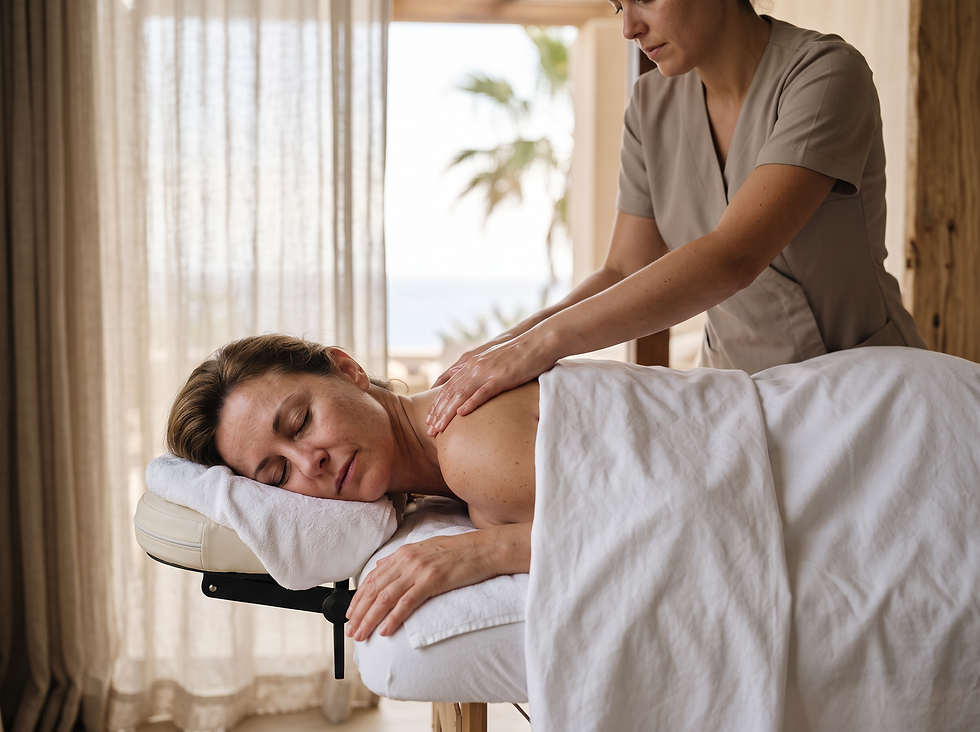
A relaxing massage speaks a different language entirely. Medium, even pressure. A slow, continuous rhythm that never really stops. No hunt for the knot, no "fixing" — the point is the flow itself.
That steadiness is the whole treatment. Slow, predictable touch is one of the oldest signals the body reads as safety, and it invites the nervous system to shift out of high alert and into recovery mode. The breath drops. The jaw unclenches. The mental noise that has been running all day goes quiet almost without your permission. This is the massage for the week that flattened you, for the head that will not switch off, for the first evening of a holiday when your body has not yet understood that it is finally allowed to stop.
Which one does your body need today?
Here is the test we use, and you can run it on yourself right now. Ask one question: where does it hurt?
If you can point to it — this shoulder, that spot in the lower back, these calves — your body is asking for deep tissue work. The problem is local, and it wants hands that go straight to it.
If your honest answer is "everywhere, I'm just wrecked" — nothing sharp, just a general, bone-deep tiredness and a mind that will not settle — then deep pressure is the wrong tool. You need the opposite signal: slow, calming, relaxing work that lets the whole system power down.
And if you genuinely cannot tell? That is exactly what the first two minutes of the session are for. Describe your week to your therapist — the flight, the deadline, the training, the bad nights — and let them choose. Reading that from your body is our job, not yours. It is also why our sessions start with a couple of questions, not with the oil.

On holiday in Gran Canaria: where to start
For most people arriving here, the honest first move is a relaxing massage. You land carrying weeks of accumulated stress, and before anything specific can be addressed, the nervous system needs to come down. Start there, sleep like you have not slept in months, and see what is left.
Often, once the general fog lifts, something specific surfaces — that one shoulder, that stubborn lower back — and the next session becomes deep tissue, aimed precisely. The two are not rivals. Our regulars move between them as their lives change: deep tissue in a heavy training block or after a brutal travel week, relaxing when the calendar has been the real problem. You do not have to marry one.
In practice
Pain you can point to: choose deep tissue.
Stress, broken sleep, tension everywhere: choose relaxing.
Book deep tissue away from big commitments — the next day your muscles will have opinions.
Firm should never mean bracing against pain. Speak up; the pressure is always adjustable.
First days of a holiday: start relaxing, then go specific once you have unwound.
Not sure which? Describe your week and let the therapist decide.
There is no best massage in the abstract. There is the one your body needs today — and the honest job of a good therapist is to give you that one, not the one on the menu you happened to point at.
Explore our massages and book your session here. Tell us how you are arriving, and we will take it from there.
Giuseppe Notarnicola, Health Performance Specialist


Comments